

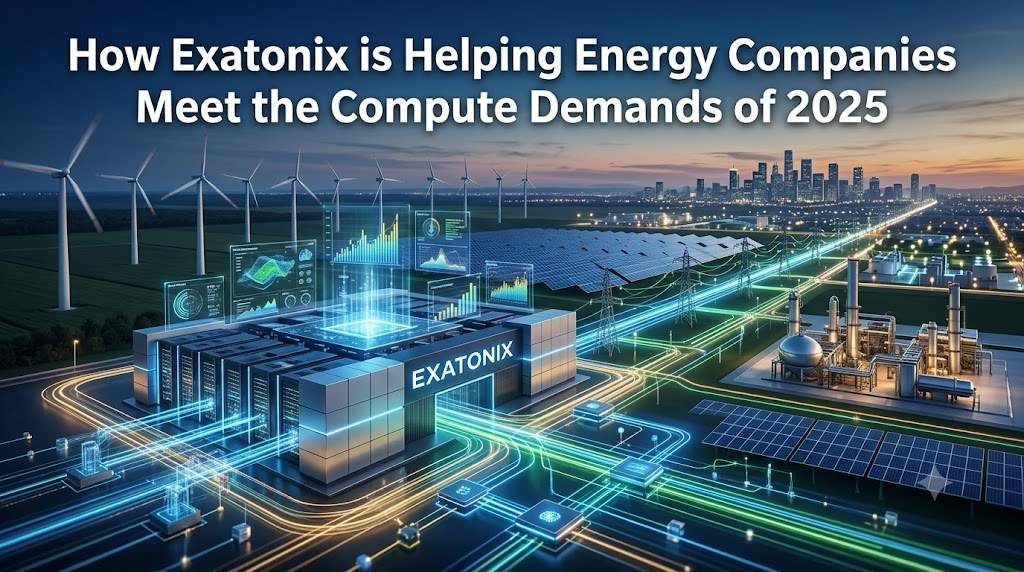
The energy sector is undergoing an AI revolution. From grid optimization and load forecasting to renewable energy trading and predictive maintenance of wind and solar assets, artificial intelligence has become indispensable to modern energy operations. But behind every AI model running in production is a massive computational backbone — and for many energy companies, that backbone is cracking under the strain.
At Exatonix, we are seeing a sharp increase in consulting engagements from energy providers who have built promising AI prototypes but cannot deploy them at scale because their computing infrastructure simply cannot keep up. The gap between a model that works in a notebook and one that runs reliably across hundreds of substations in real time is where most AI initiatives stall. Bridging that gap is what we do.
The Compute Bottleneck in Energy AI
Consider a mid-sized regional energy provider managing 200+ substations with a portfolio that includes wind, solar, and natural gas assets. The company wants to deploy neural networks for three critical use cases:
1. Real-time load forecasting — predicting electricity demand at 15-minute intervals across all substations to optimize dispatch
2. Predictive maintenance — analyzing sensor data from wind turbines and solar inverters to flag components likely to fail within the next 30 days
3. Renewable energy trading — using weather prediction models and historical generation data to optimize bidding strategies in day-ahead and intraday energy markets
Each of these use cases requires significant compute. The load forecasting model alone, running inference every 15 minutes across 200 substations, generates over 19,000 predictions per day. The predictive maintenance pipeline ingests streaming telemetry from thousands of IoT sensors and must process it through deep learning models with sub-second latency to catch emerging fault patterns. The trading system runs Monte Carlo simulations layered on top of weather forecast ensembles — a computationally intensive process that must complete before market closing windows.
For most regional energy providers, the on-premise infrastructure to support this workload does not exist. And building it is prohibitively expensive — a single high-performance GPU server capable of handling the inference load can cost upwards of $100,000, with power and cooling requirements that strain the very energy infrastructure the company is supposed to be optimizing.
The Exatonix Approach: Right-Sized High-Power Computing
Exatonix’s consulting engagement typically begins with a comprehensive infrastructure audit. We assess the client’s existing compute resources, data pipelines, model architectures, and — critically in the energy sector — their power and cooling capacity. Many energy companies are surprised to learn that their own facilities’ power management systems can be integrated with their AI compute infrastructure to achieve significant efficiency gains.
Our engagement with a Wyoming-based energy cooperative illustrates the approach. The cooperative had developed a sophisticated neural network for wind turbine predictive maintenance but could only run it on a batch basis — processing the previous day’s sensor data overnight. This meant fault detection was always 12 to 24 hours behind real time, rendering the system nearly useless for preventing unexpected turbine shutdowns.
Exatonix designed and deployed a high-power computing solution that enabled real-time inference. The key innovations were:
– GPU cluster optimization: Rather than purchasing new hardware, we reconfigured the cooperative’s existing servers using containerized GPU orchestration, achieving a 3.5x throughput improvement on the same infrastructure
– Edge computing deployment: We distributed lightweight inference models to edge devices at each wind farm, reducing the data that needed to be transmitted to the central cluster by 80%
– Adaptive batch sizing: We implemented dynamic batch sizing algorithms that adjusted inference batch sizes based on real-time sensor data volume, ensuring that critical fault signals were never delayed by non-critical processing
The result: fault detection latency dropped from 12-24 hours to under 90 seconds. In the first three months of operation, the system flagged three bearing failures and one gearbox anomaly that the previous batch process would have detected too late — saving the cooperative an estimated $340,000 in emergency repair costs and avoided downtime.
The Energy-AI Feedback Loop
One of the most interesting aspects of our work in the energy sector is what we call the energy-AI feedback loop. AI systems require substantial energy to run, but they also have the potential to optimize the very energy systems that power them. This creates an opportunity for closed-loop optimization that is unique to the energy industry.
For example, a solar farm operator using AI to optimize panel orientation and inverter load can use the same AI framework to schedule compute-intensive model training during peak solar generation hours — when electricity is essentially free and surplus capacity exists. Conversely, inference workloads can be shifted to periods of lower energy demand to reduce strain on the grid.
Exatonix helps energy companies design these feedback loops from the ground up, ensuring that AI infrastructure and energy infrastructure are designed as an integrated system rather than separate silos.
What’s Next: The 2026 Inflection Point
The energy AI market is at an inflection point. The convergence of three trends — cheaper GPU compute, mature edge computing hardware, and industry-standard AI frameworks tailored for time-series and IoT data — has made it possible for even small energy providers to deploy production-grade AI systems.
But the window for first-mover advantage is closing. Companies that establish AI-optimized operations now will build compounding data advantages that make their models increasingly accurate over time. Companies that wait will find themselves competing against AI-augmented peers who can predict demand more accurately, maintain assets more proactively, and trade energy more profitably.
Exatonix is expanding our energy-sector consulting practice to meet this demand. Our team combines AI expertise with deep infrastructure engineering experience, and we have a track record of delivering measurable results — from 3.5x compute throughput improvements to six-figure cost savings through predictive maintenance.
For energy companies ready to move from AI prototypes to production-scale AI operations, the conversation starts with infrastructure. That is where Exatonix comes in.
Exatonix provides AI consulting, high-power computing infrastructure, and neural network integration services to businesses across the energy sector and beyond. Headquartered in Sheridan, Wyoming, we help organizations scale their AI initiatives from concept to production.